Price
Turkish Apples Price
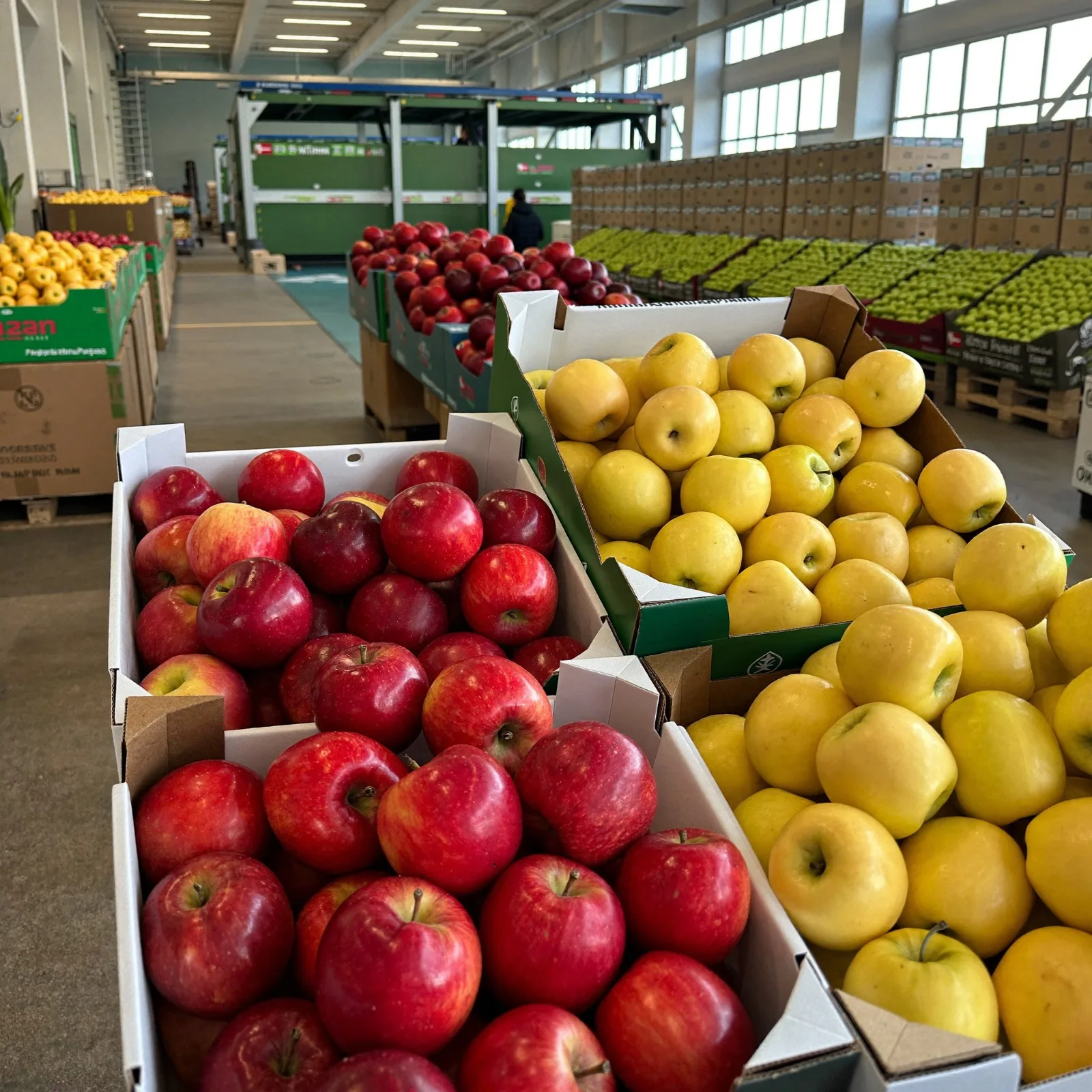
What affects Turkish apples price
The first important factor is variety. Different Turkish apple varieties have different market value. Red apples, Golden, Gala, Fuji and Granny Smith do not usually sell at exactly the same level. Some varieties are more common and more widely available, while others are produced in smaller volumes or are placed in more premium market segments.
The second factor is calibre. Bigger apples usually cost more than smaller ones because they are more attractive for retail sale and often more difficult to produce in large, uniform volumes. In commercial trade, size has a strong effect on price, especially when buyers want fruit for supermarkets or higher visual standards.
Colour is another important price factor, mainly for red and bicolour varieties. Apples with stronger and more even colour usually have higher market value than fruit with weaker colour coverage. For Golden and Granny Smith, colour also matters, but in a different way depending on the variety standard.
Packaging and presentation
Packaging is part of Turkish apples price because it changes both cost and market use. Apples packed in 13 kg cartons usually have a different commercial position than apples packed in 18 kg bushel-style cartons. Smaller export cartons often give better fruit protection and a cleaner presentation. Larger cartons may reduce packaging cost per kilogram and are often used in more price-focused channels.
For this reason, price cannot be compared correctly without looking at the packaging type. Two offers may look similar at first, but if the carton format is different, the commercial value is also different.
Season and storage
Season timing has a major effect on Turkish apples price. In a normal year, prices are usually more competitive during the main harvest period, when the largest volume of fruit enters the market. As the season moves forward and more apples go into storage, prices often become firmer.
This happens because available stock becomes smaller over time and storage creates additional cost. Fruit kept in cold rooms for later sale may also have different value depending on the storage method and the remaining shelf life. Apples sold soon after harvest and apples sold after months in storage are not the same commercial product, even if they are the same variety.
Supply and crop conditions
Turkish apples price is also influenced by supply conditions. Weather has a strong effect on both crop size and quality. Frost, hail and drought can reduce the total volume of apples and lower the share of fruit suitable for fresh export. In such seasons, prices usually rise because good-quality apples become less available.
When supply is tight, large calibre fruit and better colour grades become even more valuable. This means the difference between standard fruit and premium fruit may become wider than in a normal year. In stronger crop years, supply is more stable and pricing is usually more balanced across the season.
Logistics and delivery terms
Transport and delivery terms are another important part of Turkish apples price. Apples can be offered on different trade bases, such as EXW, FOB, CFR, CIF or other delivery structures. These terms affect what is included in the final price.
A price from the packing house in Turkey is not the same as a delivered price to a foreign port or warehouse. Freight, insurance, port costs and inland transport can all change the final number. Because of this, Turkish apples price always depends not only on the fruit itself, but also on how far it must travel and under which delivery terms it is sold.
Different markets, different price levels
Turkish apples are sold to many foreign markets, and each market has its own price expectations. Some destinations mainly buy standard commercial grades in larger volumes. Others require better colour, larger size, stronger packaging and more detailed documentation. This creates different price levels even for apples from the same origin.
Wholesale markets, supermarket chains and premium retail programs do not usually buy the same product in exactly the same form. As a result, Turkish apples price changes according to the market segment and the commercial standard of the order.
Turkish apples price as a commercial range
Turkish apples price should be seen as the result of several connected factors. Variety, calibre, colour, packaging, season, storage and logistics all shape the final offer. Because of this, one price alone does not describe the full value of the product.
A correct understanding of price must include the full product specification. Apples of the same variety may have a lower or higher value depending on size, appearance, storage condition and delivery terms. In this way, Turkish apples price is not only a number. It is part of the full commercial identity of the fruit.
For this reason, price is one of the main elements that defines Turkish apples in export trade. It shows how the fruit is positioned across wholesale, retail and international distribution, and it explains why different offers from the same origin can vary so much in the market.